

What we know, what we hypothesise and what we don’t know.
Right now, there is almost nothing about training and the female hormone cycle that we know with absolute certainty. This is for two reasons. First, only 6% of sports science research is done exclusively on women. Second, the majority of that research is poor quality since it did not measure female hormones, but instead guessed by “phase”. With their widely varying hormone levels, “phases” such as luteal, follicular, have no place in sports science.
Given the significant variation from one woman to the next, measuring by “phases”is simply hormone roulette, which since the entire purpose of the research is to understand the effect of hormones on sport, means we cannot accept the results. The good news is that some of the top sports scientists were as annoyed by this as I am, and wrote this timely paper: Why We Must Stop Assuming and Estimating Menstrual Cycle Phases in Laboratory and Field-Based Sport Related Research, and researchers have taken note as we see in this paper from February 2026: https://pubmed.ncbi.nlm.nih.gov/41460237/
The other good-ish news is that we have a lot of research about the physiological effects of female hormones from other fields. For instance, we know that progesterone increases body temperature and respiration rate. These are established facts. Since we know how rising and falling levels affect the body, we can hypothesise the effects on training, recovery and adaptation.
The actual good news for users of The Running Algorithm
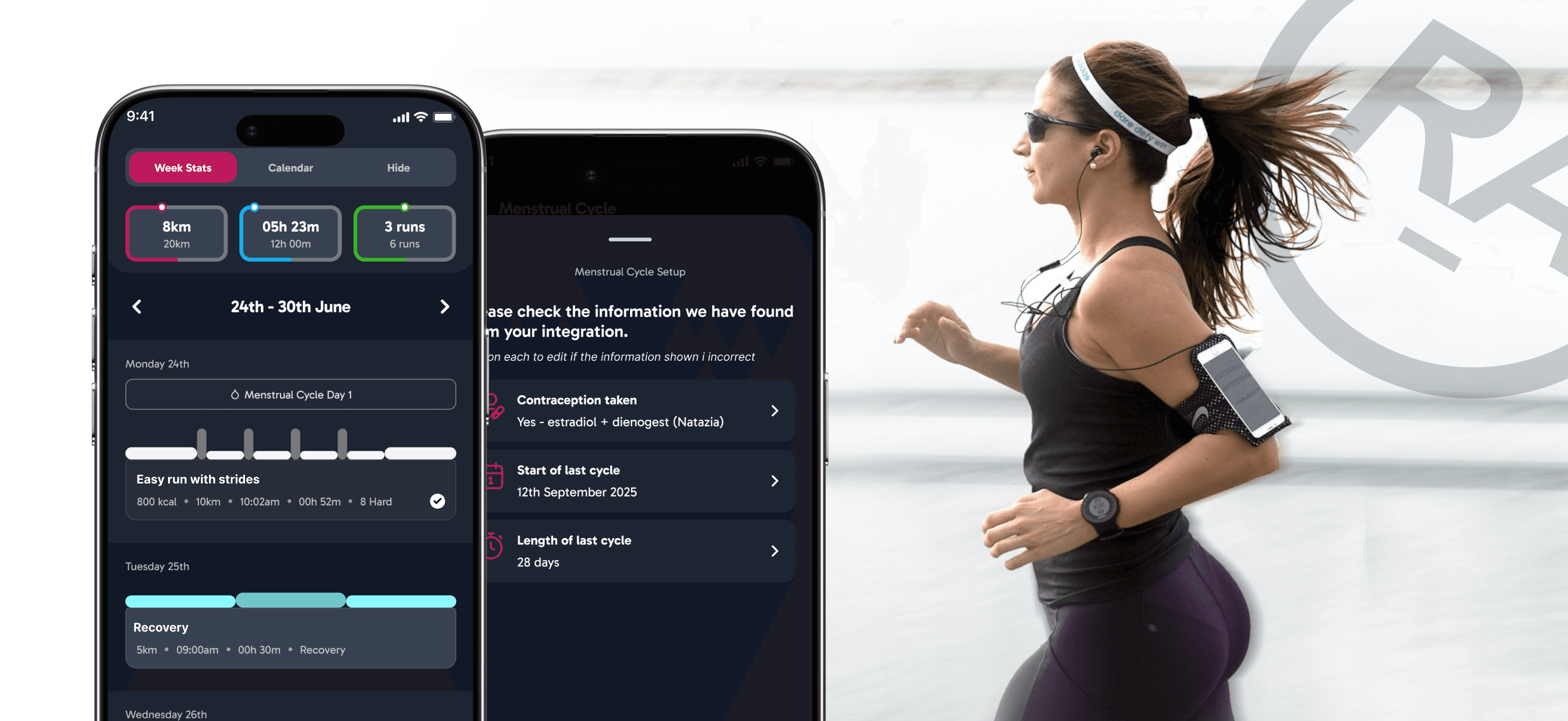
The Running Algorithm is light years ahead of the research curve because the fatigue model is individualised and responds to how you, personally, react to different hormone levels in your body, rather than relying on broad brush guesses based on what is little more than hormone roulette. We are excited to see researchers taking onboard the necessity of actually measuring hormones to determine the effects of hormones on physiology (wild, right?), but given the traditionally slim pickings for women in scientific research, we are likely years, or even decades away from having the full picture. With The Running Algorithm, there’s no more wondering, and no more gaslighting; even if your data looks good, if you tell us you felt like you were running through treacle we’ll believe you and adapt your training.
How female hormones influence training: what the evidence suggests
Oestrogen: a possible performance boost?
Oestrogen levels rise in the first half of the cycle, peak just before ovulation, and then climb again moderately in the second half. During those higher-oestrogen windows, athletes may notice subtle boosts in performance and recovery.
Why?
Muscle recovery: oestrogen has anti-inflammatory effects, potentially reducing muscle damage after exercise.
Antioxidant protection: it may help to buffer oxidative stress from hard efforts or high training loads.
Fuel use: it nudges metabolism to use more fat for fuel and spare more carbohydrate, useful for endurance performance.
Neuromuscular function: some studies suggest improved coordination and force production when oestrogen is elevated.
Together, these effects may make hard sessions feel smoother, recovery more efficient, and sustained efforts more economical, though individual experiences vary widely.
Progesterone: possibly not that beneficial for some athletes?
Progesterone stays low until ovulation, then rises through the second half of the cycle. While essential for overall health and hormonal balance, higher progesterone levels might make training feel harder.
Possible effects include:
Higher core temperature: the thermogenic effect can accelerate fatigue, especially in heat.
Catabolic tendencies: it may dampen muscle repair and/or adaptation, countering oestrogen’s protective role.
Central fatigue: as a central nervous system depressant, it can lower motivation and alertness.
Cardiovascular strain: higher ventilation and heart rate responses can make the same workload feel more taxing.
Respiration: faster respiration rate combined with a higher sensitivity to carbon dioxide can make zone 4-5 work feel much harder (the complex interplay between brain and body might mean that the signals that tell us we are working hard are louder or occur sooner).
When progesterone dominates, particularly if oestrogen is low, some athletes describe feeling flatter or less responsive to training. Progesterone levels are highly variable so it’s possible that women who do experience this simply have higher levels.
What this means in practice - an emerging hypothesis:
Performance potential and recovery may depend less on fixed cycle phases and more on relative hormone levels and personal responses to them. Training that aligns (when possible) with more favourable hormonal conditions, or at least recognises when the body may need extra support, could help optimise adaptation over time.
Right now, the science isn’t definitive enough for precise prescriptions, but awareness matters. Understanding why you feel the way you do and having a schedule that adapts to that, every day of every month, can make a big difference.
So next time you see a post telling you to “lift heavy in the follicular phase” remember that “the follicular phase” includes both the days of your lowest overall hormones and the highest peak of oestrogen so it is, scientifically-speaking, nonsense.
The best thing you can do is focus on how your body feels across the hormone cycle. Until the science catches up, the most effective approach is one that adapts to your individual patterns and daily fluctuations. Your hormone levels are personal, your responses are personal, and your training should be too.