

Runners struggle to know the difference between threshold and VO2 max training, often just running as hard as possible every session. It’s not always the goal to go as hard as possible in every interval though.
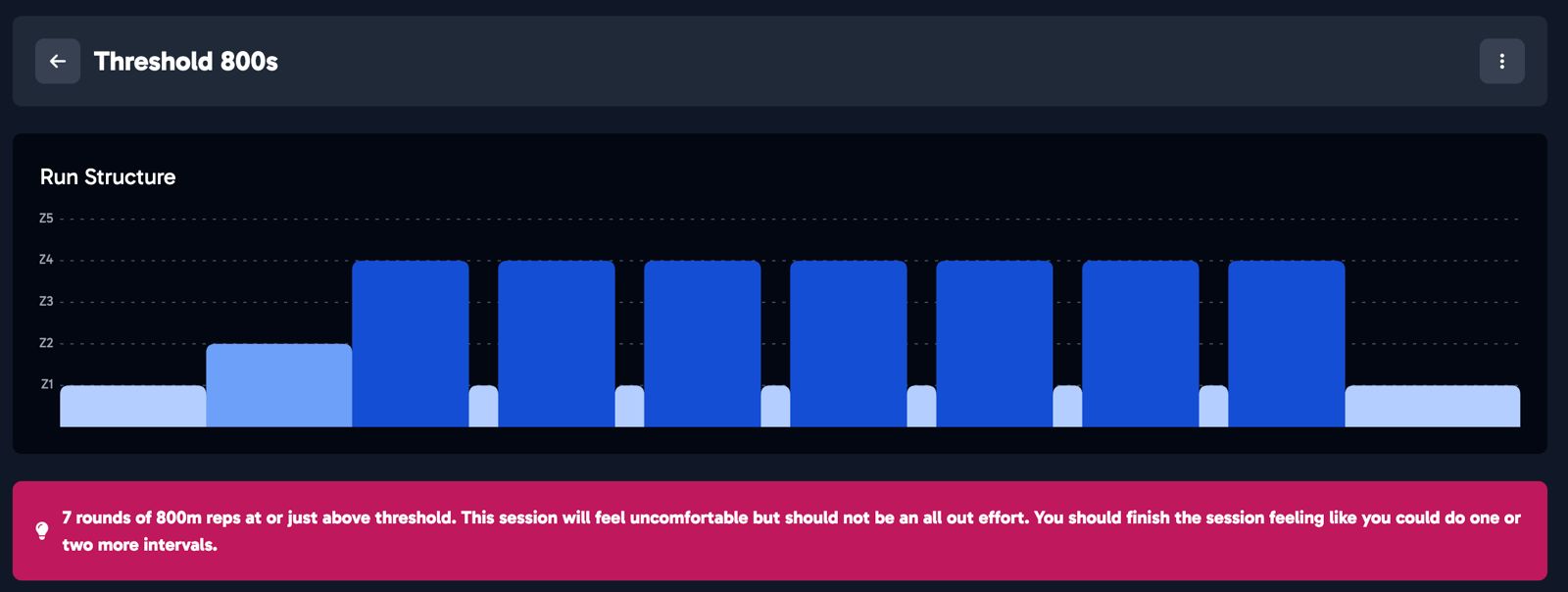
Threshold intervals are longer and usually around your 10km pace (depending on the length of the intervals and the individual characteristics of the athlete). Training at lactate threshold improves your ability to use and clear metabolic byproducts at a hard pace. Training just below this (what cyclists call the “sweet spot” and runners often call “tempo”) also generates these adaptations at a slightly slower rate but with considerably less fatigue.
If you have a long threshold session with long intervals then you want to be cruising just below threshold. A shorter session with shorter or fewer intervals can be done at or just over threshold.
But what actually is threshold?
How do you know what that is without heading to a lab for testing? Both types of threshold sessions should feel hard but very doable. Expect heavier, but controlled breathing, relatively stable heart rate for each rep (once it has come up it should level off rather than continue to rise). For shorter sessions your legs should start to feel uncomfortable, some describe a burning sensation, particularly in the quads (this isn’t caused by “lactic acid”, but that’s another blog!). You might be able to talk in short, or broken sentences but a full conversation shouldn’t be possible.
And what about VO2max?
VO2 max sessions on the other hand are run at a very high intensity, 5km race pace and faster. They are shorter than threshold intervals and your heart rate will rise to 95-100% of your max. Training at this pace takes practice, it can feel very uncomfortable, your breathing might feel almost uncontrolled and you will need to walk or jog the recovery very slowly. You shouldn’t be able to talk. You will probably start making bargains with yourself, or counting down the metres or laps. You might start questioning your life choices.
What are the main physiological adaptations from interval sessions?
Training triggers signals in the body that eventually lead to adaptations. When lactate accumulates and there is sustained metabolic stress (like during a threshold session), something called AMPK is activated. AMPK switches on genes that then upregulate PGC-1a, increase mitochondrial biogenesis, increase lactate transporters and upregulate oxidative enzymes.
Together - and with other signals - this causes your body to adapt. These adaptations eventually make you fitter and faster. Specifically, better at running fast!
All the sessions you’ll get from The Running Algorithm begin with a discussion about desired adaptations - and how we get as much adaptation as possible with the least fatigue. The aim with every training run is to find the perfect point where you maximise your adaptation but aren’t so tired that you can’t walk the next day.
Our threshold sessions are designed to improve your body’s ability to clear lactate, increase mitochondrial density (your aerobic engine), and raise your lactate threshold (so you can run faster for longer!). Our VO2max sessions are designed - of course - to increase your VO2max.
This happens because your body adapts with faster oxygen delivery to your muscles, more mitochondria and capillaries, increased power (and sustained power), and more efficient communication between the brain and the muscle fibres (neuromuscular communication).
When talking about threshold and VO2max training, we say that threshold raises the floor of sustainable pace, and VO2max raises the ceiling.
Why do we need to train both when some of the adaptations are the same?
An athlete with a high VO2max, but low threshold can run fast for a few minutes but can’t maintain that pace. For example, Femke Bol’s threshold pace is 4:20 / km, meaning one of the fastest 800m runners of all time would struggle to break 40 minutes in a 10km race. She has a sky high VO2max but relatively low threshold. A runner with a lower VO2max and higher threshold will be able to maintain a decent pace for a long time but won’t be able to accelerate much beyond it (so might have a better marathon time than 5km, relatively speaking).
Endurance runners need to maximise both VO2max and lactate threshold in order to truly reach their potential. Threshold training is also much more sustainable than VO2max training, meaning runners can accumulate a much longer time running at this pace. You might be able to do a couple of threshold sessions each week no problem, but usually one VO2max session a week is enough for most runners.
How can I avoid this mistake?
Each session from The Running Algorithm has prescribed pace goals, and they shouldn’t all be maximal efforts. The best way to avoid this mistake is to run your sessions at the goal pace range, not faster. This will ensure you maximise adaptation, while minimising fatigue.