
Improving your running with science
Improving your running with science
TRA’s Fatigue Model
And how it makes you improve faster
And how it makes you improve faster
Everything we build here at The Running Algorithm is based on the principle that runners who train as consistently as possible get better the fastest. This can’t be achieved without paying careful attention to whether each run felt as it should. An easy run feeling harder than it should have done is a signal that you’ve not recovered sufficiently from your last hard session and might need to reduce the intensity of your upcoming training.
So how do we bake this principle into the way we optimise your training sessions? The Running Algorithm is built on a mathematical model of your fatigue - it predicts how tired you are and how quickly you recover from a run. Fatigue modelling is exactly what a human coach does, whether or not they’re conscious that they are doing it. They will plan your training sessions, predicting how each run will impact the next, then will adjust future training sessions based on feedback given to you. Each run produces a sort of ‘fatigue impulse’ which fades until the next run. Your personal recovery will have more factors that feed into it than you can imagine, and of course, will be different from run to run. Your recovery from your last run dictates what you can do next - if you’re feeling good you can train significantly harder than if you’re feeling bad.
Everything we build here at The Running Algorithm is based on the principle that runners who train as consistently as possible get better the fastest. This can’t be achieved without paying careful attention to whether each run felt as it should. An easy run feeling harder than it should have done is a signal that you’ve not recovered sufficiently from your last hard session and might need to reduce the intensity of your upcoming training.
So how do we bake this principle into the way we optimise your training sessions? The Running Algorithm is built on a mathematical model of your fatigue - it predicts how tired you are and how quickly you recover from a run. Fatigue modelling is exactly what a human coach does, whether or not they’re conscious that they are doing it. They will plan your training sessions, predicting how each run will impact the next, then will adjust future training sessions based on feedback given to you. Each run produces a sort of ‘fatigue impulse’ which fades until the next run. Your personal recovery will have more factors that feed into it than you can imagine, and of course, will be different from run to run. Your recovery from your last run dictates what you can do next - if you’re feeling good you can train significantly harder than if you’re feeling bad.
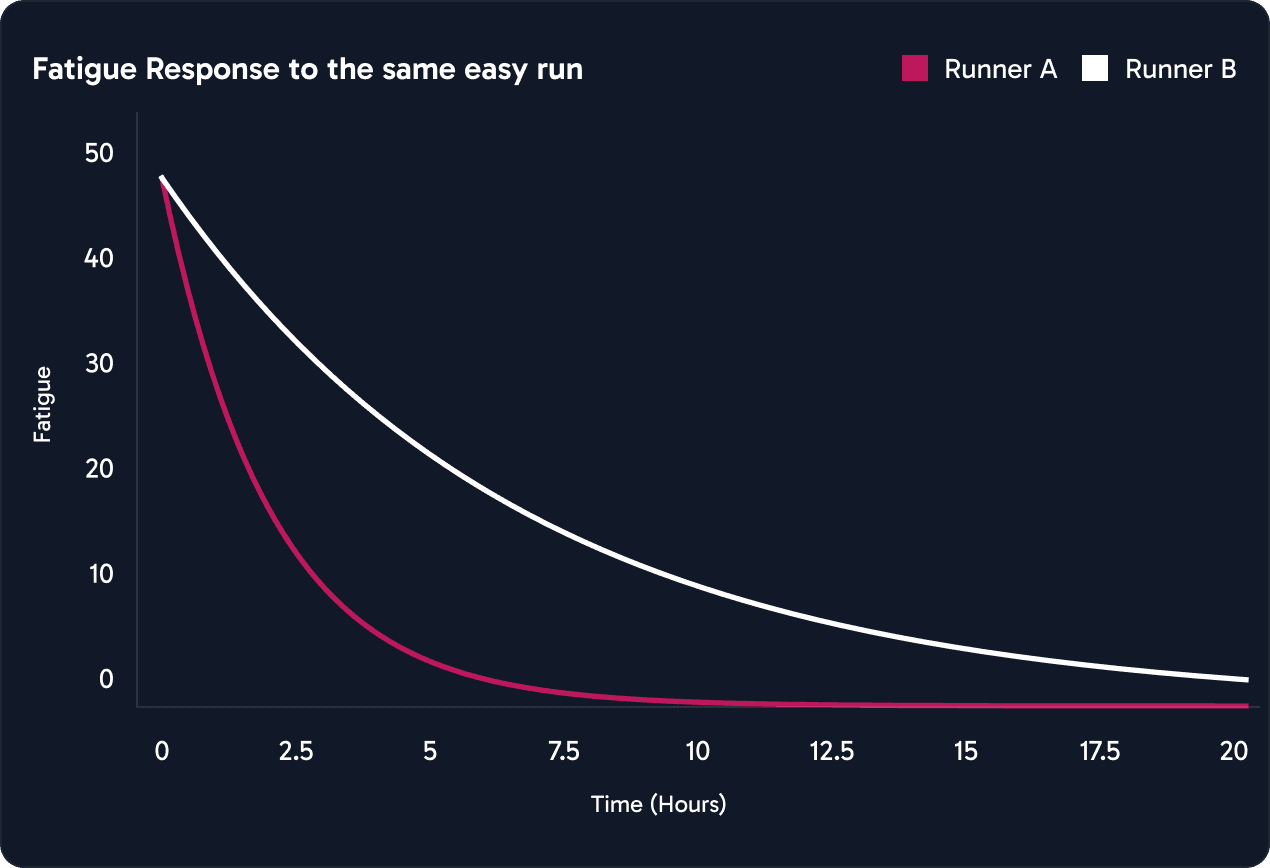
Caption: If two runners do the same run, they won’t recover at the same rate even if they have the same ability. Imagine both of these runners train the same amount, but one has kids and a stressful job and the other has a trust fund. Their personal stress levels are different with one being able to take a nap while the other has to do the school run then get to the office. As such, Runner A recovers much faster than Runner B and can run again sooner.
Caption: If two runners do the same run, they won’t recover at the same rate even if they have the same ability. Imagine both of these runners train the same amount, but one has kids and a stressful job and the other has a trust fund. Their personal stress levels are different with one being able to take a nap while the other has to do the school run then get to the office. As such, Runner A recovers much faster than Runner B and can run again sooner.
When you run, your bones, ligaments, muscles and tendons get damaged. If you do a long or hard run then this damage is greater than if you do a short or easy run. Our fatigue model records this as a larger fatigue impulse.
The amount of damage that’s done after each run depends on how much experience you have, and the process of repair after each run builds your muscles and tendons back stronger, this process is faster for more experienced athletes. Runners get themselves into trouble when they do too much running before the repair process has finished - and eventually the small pieces of damage can turn into big problems.
After each run, it’s impossible for you to know the exact state of these tissues. The only information you really have is how far you ran, how fast you ran, and some internal metrics like heart rate and feeling. Damaged muscles and tendons don’t respond quite as well as fresh ones to running, which is why when you’re feeling tired your easy runs feel much harder than the pace reflects. A torn muscle can’t produce as much force as a recovered one, and a slightly inflamed tendon cannot return as much energy as a fresh one.
The Running Algorithm records all the metrics of each run, but we need you to tell us how each felt in order to get an idea of how tired you are afterwards. We don’t use RPE (Rate of Perceived Exertion), but a divergence from “normal” - some runs are meant to feel hard, and when they do that’s ok, but if an easy run feels hard then it’s a red flag.
When you run, your bones, ligaments, muscles and tendons get damaged. If you do a long or hard run then this damage is greater than if you do a short or easy run. Our fatigue model records this as a larger fatigue impulse.
The amount of damage that’s done after each run depends on how much experience you have, and the process of repair after each run builds your muscles and tendons back stronger, this process is faster for more experienced athletes. Runners get themselves into trouble when they do too much running before the repair process has finished - and eventually the small pieces of damage can turn into big problems.
After each run, it’s impossible for you to know the exact state of these tissues. The only information you really have is how far you ran, how fast you ran, and some internal metrics like heart rate and feeling. Damaged muscles and tendons don’t respond quite as well as fresh ones to running, which is why when you’re feeling tired your easy runs feel much harder than the pace reflects. A torn muscle can’t produce as much force as a recovered one, and a slightly inflamed tendon cannot return as much energy as a fresh one.
The Running Algorithm records all the metrics of each run, but we need you to tell us how each felt in order to get an idea of how tired you are afterwards. We don’t use RPE (Rate of Perceived Exertion), but a divergence from “normal” - some runs are meant to feel hard, and when they do that’s ok, but if an easy run feels hard then it’s a red flag.
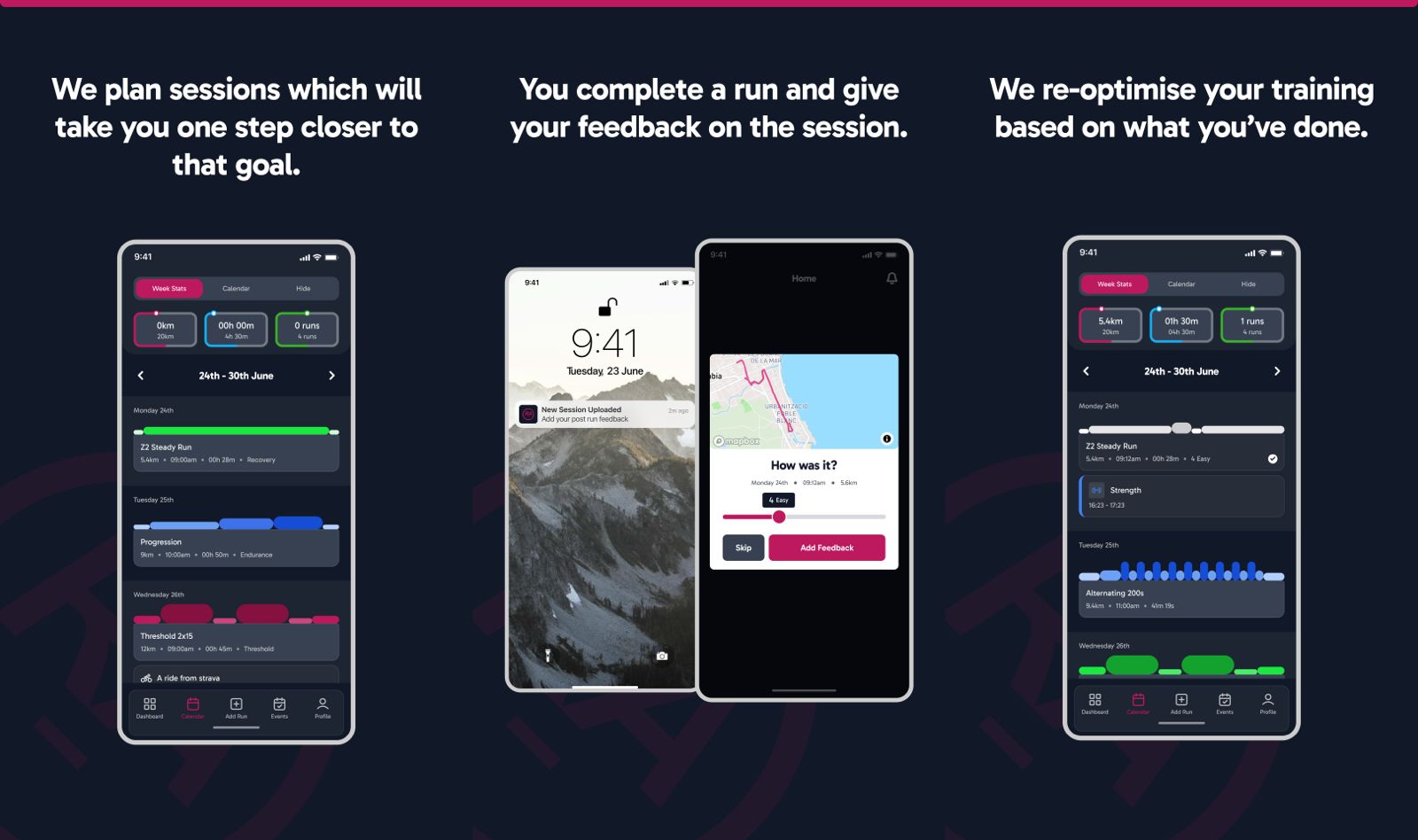
After each piece of feedback, our model recalibrates. It has an idea of how tired you are along with how the run should have felt. Then, you tell us how the run actually felt - and the model adjusts accordingly from your feedback. This helps it learn how fast you recover from running and how other activities typically impact your running, which then allows us to calculate how much “allowed fatigue” you’re likely to have when it comes to your next planned run. After each piece of feedback, your training plan will update to reflect your newly calibrated state of fatigue.
The fatigue model informs what training load you can tolerate next. The fatigue model indicates how much training load you can tolerate next, but it does not decide the specific type of session you should do. Training load can be distributed in many ways. For example, 3x1km at 5k pace could be quantified the same as 6x1km at Half Marathon pace, but which of these two training sessions you do can depend on many factors - such as how you respond to different types of intensity, your personal physiological limiters and what you’re training for.
Here at The Running Algorithm, we’ve built a training session generation algorithm which builds loads of sessions from constituent parts within the bounds set by the fatigue model and then picks the most optimal of these training sessions.
After each piece of feedback, our model recalibrates. It has an idea of how tired you are along with how the run should have felt. Then, you tell us how the run actually felt - and the model adjusts accordingly from your feedback. This helps it learn how fast you recover from running and how other activities typically impact your running, which then allows us to calculate how much “allowed fatigue” you’re likely to have when it comes to your next planned run. After each piece of feedback, your training plan will update to reflect your newly calibrated state of fatigue.
The fatigue model informs what training load you can tolerate next. The fatigue model indicates how much training load you can tolerate next, but it does not decide the specific type of session you should do. Training load can be distributed in many ways. For example, 3x1km at 5k pace could be quantified the same as 6x1km at Half Marathon pace, but which of these two training sessions you do can depend on many factors - such as how you respond to different types of intensity, your personal physiological limiters and what you’re training for.
Here at The Running Algorithm, we’ve built a training session generation algorithm which builds loads of sessions from constituent parts within the bounds set by the fatigue model and then picks the most optimal of these training sessions.
The primary aim of the fatigue model is to keep you consistent by making sure all your sessions are doable. The more consistent you are over a long period, the more you’ll improve. The reason for this is simple: running more makes you fitter, running too much makes you injured. Hero runs and huge training weeks are not good for your consistency in the long term. Sometimes, short term gains must be sacrificed for long term risk reduction.
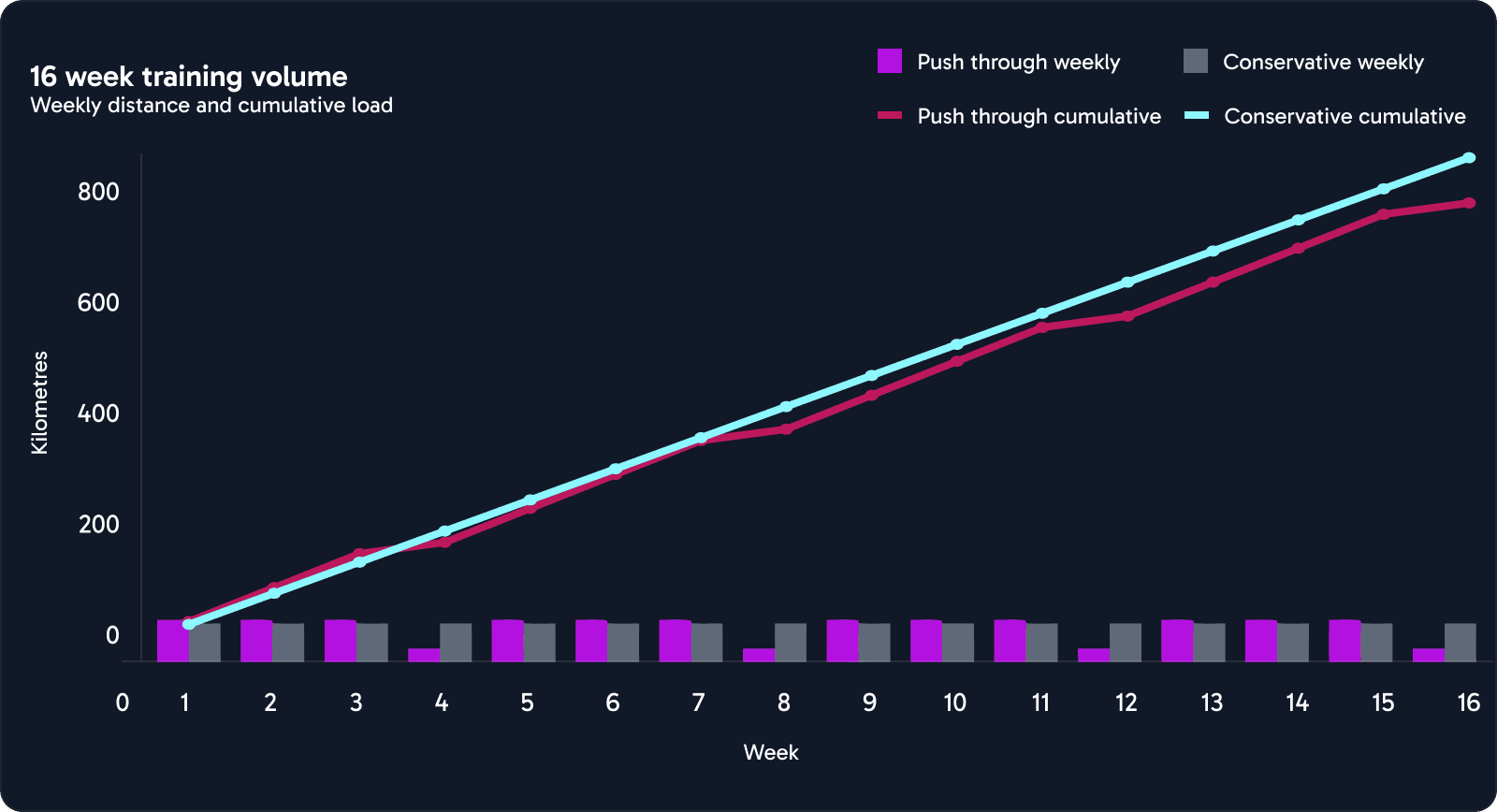
Imagine two versions of the same runner. One pushes through pain and tiredness to run 60km a week for 3 weeks but then has to take a week with a few extra days off so they end up running three weeks at 60km, one week at 20km. The other backs off a little when they feel heavy legs and small amounts of pain, and ends up cutting 5km from each training week. Despite running less each week, they never need to take extended days off. After a 16 week block of training for a big goal, their total training volume looks like this:
The primary aim of the fatigue model is to keep you consistent by making sure all your sessions are doable. The more consistent you are over a long period, the more you’ll improve. The reason for this is simple: running more makes you fitter, running too much makes you injured. Hero runs and huge training weeks are not good for your consistency in the long term. Sometimes, short term gains must be sacrificed for long term risk reduction.
Imagine two versions of the same runner. One pushes through pain and tiredness to run 60km a week for 3 weeks but then has to take a week with a few extra days off so they end up running three weeks at 60km, one week at 20km. The other backs off a little when they feel heavy legs and small amounts of pain, and ends up cutting 5km from each training week. Despite running less each week, they never need to take extended days off. After a 16 week block of training for a big goal, their total training volume looks like this:
The fatigue model updates continuously after planned runs as well as other activities like gym sessions, netball games, hikes,bike rides or unplanned runs. Our fatigue model learns how long it takes you to recover from runs, and how other activities impact your recovery state. This allows it to set new guardrails after every run, enabling the run generation algorithm to select the run which balances your fitness goals while minimising the risk of injury.
The fatigue model updates continuously after planned runs as well as other activities like gym sessions, netball games, hikes,bike rides or unplanned runs. Our fatigue model learns how long it takes you to recover from runs, and how other activities impact your recovery state. This allows it to set new guardrails after every run, enabling the run generation algorithm to select the run which balances your fitness goals while minimising the risk of injury.


Got a question about our programming or app? Drop us a message below or send and email to support@runningalgorithm.info
Send us a message
Send us a message
Send us a message